Hello all.
I have moved to a new home! Thank you for your visit, even though I haven't been updating this blog I still manage to get more than 40 hits in one day.
SUPER THANKS!
The new webpage can be accessed here.
Eat well, exercise when you can, and take care of your loved ones.
Cheers,
Jasmin.
Showing posts with label author. Show all posts
Showing posts with label author. Show all posts
Lyneham Wetland, Canberra
A community park is a very desirable place in a neighborhood. Rapid developments especially in city centers have caused more and more buildings to be built causing less and less public open spaces. People depend on community parks as a place for retreat, exercise and recreation. The role of public community parks is becoming more important as people are more aware of their health status.
The closest community park to where I live in Lyneham, Canberra is the Lyneham Wetland. This constructed wetland is relatively new. Only recently the sign describing features of this park was built. I consider myself lucky as i get to see the growth of this wetland for the next three years.
This wetland carries 3 purpose-- as a wetland, as a park and it connects the cycling path throughout Canberra.
Canberra has an excellent bicycle/footpath that connects several suburbs right to the city, and i use this path everyday to get to school.
The main purpose of this wetland is to improve the quality of urban stormwater in the Sullivans Creek Catchment. It harvests the stormwater network at the inner north part and also captures runoff from surrounding suburbs. As designers, it is important to understand groundwater flow and identifying the best location to be turn into a stormwater catchment. Improper planning and poor analysis can result in inefficient design of water bodies and can further worsen a flashflood effect.
I went for a stroll with my little man and captured some photos of the site.

[1] View of the (almost) the entire lake. The banks of the lake are connected by a bridge that overlooks the ducks swimming in it. There are several signs that says-- do not feed the birds. Feeding a wildlife animal can result it these animals being dependent at humans, making them lazy to find food for themselves.

[2] View of the bridge

[3] The bridge is wide enough for a wheelchair, making it accessible for everyone. I reckon the slope degree also to the benefit of wheelchair users.

[4] View from one of the bench located throughout the site. The developer uses plant species that resembles a real wetland. This can also help lessen maintenance cost as use of plants that need proper maintenance increases cost.

[5] Another view of the lake

[6] Information on the lake and features it has.

[7] View of the wetland wall (flume), designed to divert high flows through the wetland and prevent build up of excess sediments and nutrients. There is even a sensor installed to detect oxygen levels. If it drops, it triggers a water mixer to begin re-circulating water in the wetland.

[8] The main drainage into the wetland, which may cause high flows into the wetland, thus having the wetland wall.

[9] Earlier in May 2014, there was a tree planting program, open for people living around this park. If only I knew there was such program, I would definitely join it.

[10] The bicycle path that leads to the city center.

[11] About 3 months ago, some workers modified the main drain that leads to this lake. I'm not sure what those two holes are for, so if you know what it is, please leave a comment :)

[12] One of the signage at this area. This one is located at the bridge, saying no cycling on the bridge.

[13] Signage indicating distance and direction for users.
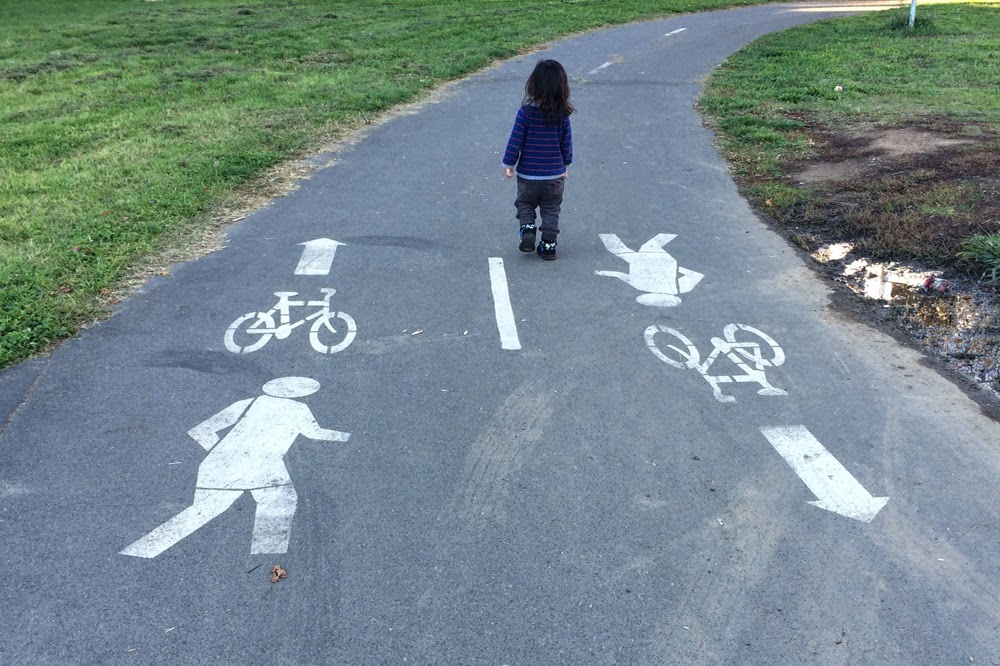
[14] The path. With my son as the model ;)

[15] Of course, where there is a park, there is a playground.
Water feature at Australia's National Portrait Gallery
It has been so long since my last update. Few months back, I was busy packing for Australia and once I have arrived I was busy settling down. I have been here since end of August and frankly, I am still adjusting and settling down.
Today we went to the National Portrait Gallery. We arrived quite late but manage to enjoy the exhibition. The building's design was modern with wonderful cement render finish that I always admire. Nothing compliments a modern building better than a water feature. The water feature complimented the lush greenery surrounding the gallery and softens the harshness of the concrete building.
The purpose of the National Portrait Gallery is to increase the understanding and appreciation of the Australian people – their identity, history, culture, creativity and diversity – through portraiture.
Next visit will be the National Museum, hopefully :)

At the end of the water feature, the catchment is equipped with wire mesh, trapping leaves and any solids.

The arrangement of tiles are repeated inside the water feature.

The ripples of the water creates soothing music for the area.

The water feature is tiered, and there is no stagnant water.

Entrance to the gallery.

The water feature from the main road.
Pruning gone wrong

Sad to say, this is a frequently seen scenario happened here, is our country. Plants that are pruned the wrong way. Even worse, pruning plants that are NOT supposed to be pruned. That is why it is so important for Landscape Architect or even home owners to know about the plants they want to use in their garden. Even if the home owner is not an expert, at least inquire information from the nursery owner about the plants they about to buy. No hurt in gaining extra knowledge, right? I was on my way to a wedding when we passed by this house. Immediately I ask my husband to capture this image.
What is pruning? How important is pruning? There are dozens of articles about these topics, please read them for better understanding.
Pruning is essentially the act of discarding old plant materials to allow the plant's resources to build new growth. This ongoing procedure will make a garden or landscape get stronger and stronger. Some people prune their plants to control its growth. Some because they want to shape their plants to certain shapes (topiary). Some of the techniques in pruning includes thinning cuts, heading cuts, pinching and shearing.
What ever the reason, we have to understand the nature of the plants around us - how it grows, how fast it grows etc. We may not be expert is plants and how to maintain/prune them, but with a little reading, it can really help.
Wisma Selangor Dredging
Every student that have the intention to pursue education outside of Malaysia must take a special English language exam. There are two types of exam. TOEFL or IELTS. I took my IELTS exam last week at British Council, KL. The Britich Council office is located at Wisma Selangor Dredging- a beautiful 4 block building with a courtyard. The ambience of the place is very cooling and relaxing. Wisma Selangor Dredging is a commercial office building, nestled along Jalan Ampang.
I managed to take just a few photos of the courtyard area because I was busy enjoying myself there :)

View from the British Council towards the courtyard. The water feature gives a very welcoming (sense of welcoming) and cooling effect.

Palms, Palas, Spider Lily and spiderwort. Even though a courtyard receives sunlight, we have to remember- tall buildings allows a brief dash of sunlight. It means, no flowering plants is suggested to be planted in the site. As can be seen here, the plants chosen are green and plants that need shade.

Surprisingly, I spotted a tropical swallowtail moth. I wonder how it got here.

Thaumatococcus daniellii.

A dash of sunlight at around 11a.m.

The water feature ensures high humidity level around this area. The aerial roots of this Ficus helps collect water and nutrients.

Refreshingly cool. At the British Council, apart from english exams, they also held English classes for kids and even for adults. So if you feel the need to improve your English, this is a very nice place to study.

Tradescantia zebrina or spiderwort. It took me quite a while to recall its name.

This plant gives an interesting dash of purple amidst the green in the courtyard.

Cobble stone paving completes the look of this courtyard.
Sungei Palas BOH Tea Centre
Eid mubarak people! Selamat Hari Raya Aidil Adha. How was your holiday? Hope all is well.
This eid, our family took a short detour to Cameron Highlands! The last time I went was during my degree years, an ecology project. We went to BOH Tea Centre at Sungei Palas. Wonderful place, fresh air and beautiful weather. The tea centre is located in Brinchang about 2km away from Kea Farm Market or 5km after town. It complements the main BOH estate in Habu, Ringlet, with its very own tea center, visitor gallery and show factory. To view the landsmarks & location map, click here.
The tea centre was designed by Hostasia Corporation. They provide efficient and comprehensive tourism, leisure and hospitality development services in Asia and Middle East. They design hotels, resorts, spas and even themed restaurants. In 2004, BOH plantations commissioned Hostasia to conceptualize, develop, build and operate a new tea centre in the Cameron Highlands. The link the its website can be reached by clicking here.
Are you a tea lover? I am. I prefer tea to coffee. Tea was said could help in preventing cardiovascular disease and cancer. There are also research evidence which indicates that drinking around four to five cups of tea a day may have a beneficial effect on two long established heart disease risk factors, high blood cholesterol and high blood pressure. Although the effect is small on an individual basis, when translated to whole population, the potential effect on heart disease risk reduction could be considerable.
However, I strongly suggest, whatever we do/eat/drink, must be done/taken moderately. Too much of so many things is always bad. Here are some photos I manage to snap before the battery of my camera drained out.

My boys :)


The tea centre.
Undergraduate project: Revealing the Landscape 2012
During my undergraduate years, the projects I've done are some of the most interesting, especially during my 1st year. I really loved seeing students' art installations and also hearing them explaining their projects. Some were very straight forward and some sounds almost too logic to be true :)


I stumbled upon this website while searching for a potential PhD supervisor. An installation project by undergraduate students. More photos can be seen from the website link below.
The text and photos are taken from http://laep.ced.berkeley.edu/blakegarden/?p=1816
The Unseen Landscape: an installation project is done by undergraduates in the Landscape Architecture Design 101 class taught by Daphne Edwards. The students were to choose a site in the garden and design an intervention/installation to highlight a landscape feature or quality. The project is up in the garden until Friday , October 12. boards and models will be in the greenhouse to view after Wednesday, Oct. 10th.


What is an Arborist?
During the first semester of Bachelor of Landscape Architecture in UPM, the students are exposed with a series of related professionals that work together with landscape architects. Some of them are engineers, architects and arborists. The term arborist seemed a bit alien as the students made funny faces when hearing it. Well, surprise kids, there are so many more things you can do for a living. Typically, as children, we were exposed to certain profession such as doctors, lawyers, architects and police officer. As we grow older, and if we were curious enough, we learn that the world is so much more than all that.
What is an arborist?
In general, an arborist specialize in raising, maintaining and removing trees. They may specialize in keeping trees healthy, planting trees or landscaping. Sometimes referred to as tree doctors, they examine and take care of trees and shrubs with structural, nutritional and disease issues. They may evaluate tree color and texture to see if there is any decay or damage. If there is a problem with a tree, the arborist might take samples and send them to a lab for examination. Arborists also perform pruning and trimming on trees and shrubs, including removing dead branches as well as living branches that are obstructions.
In Malaysia, there are not that many arborists, yet. According to their website, the list showed about 50+ members. You can access the website by clicking here. Do browse through and who knows, you might be interested in joining them :)


photos from http://laep.ced.berkeley.edu/blakegarden/
What is landscape architecture?
What is landscape architecture? In Malaysia, why do people always associate landscape architecture with gardeners or 'tukang tanam pokok'? People misunderstand the profession and importance of a Landscape Architect. Not all Malaysians understand or even know what landscape architecture is all about. Even some of our 1st year students joined this course, not knowing what landscape architecture is all about.
I may write about this later but for now, I am sharing this youtube video about what is landscape architecture. It was uploaded on 2008. Filmed as part of the Landscape Institute's "I want to be a landscape architect" campaign, twelve top landscape architects describe their unique profession.
For more information, visit www.iwanttobealandscapearchitect.com.
Container classroom
Me and my husband has always wanted to buy a recycled container (kontena) and renovate it to make it our studio. If we were crazy enough, we would make a small house out of it. But, lack of skilled worker is a limitation that we faced. Of course, we have experts! However my budget is just waaaay beyond what we can afford to pay these experts. Oh well, a concrete house would do, for now. Will definitely put our dreams on paper and finally on ground. I came across lots of images and projects about wonderful projects using recycled container.
Image below shows an office made of recycled container. Ohh I so want this!

image from here
I also came across a project by Adam Kalkin, which is also interesting but he took the container home concept to a bigger scale. Not the standard small container we Malaysians always see at construction sites. One of his project can be found here.
What interest me the most is a project done by Tsai Design Studio - a school! It is located at
Durbanville, Capetown. The school - Vissershok Primary School, is a rural school dedicated to the children of farm workers and underprivileged communities living in Du Noon. This project is sponsored by three South African companies – Woolworths, Safmarine and AfriSam. For further reading, click here.
Below are some of the images from the website.

A visit to PJ Trade Centre
Last semester the 2nd year studio went for a visit to PJ Trade Centre near Damansara Perdana. The Centre is actually a cluster of 'naked' skyscrapers, housing 4 towers. Tower A is Menara Mustapha Kamal (not the actor), Tower B is the new BATA headquarters, Tower C is Menara Hasil (Income Tax) and Tower D is owned by the Perak Clay and chemical manufacturing group Taiko. The lanscape was designed by the famous Seksan. I always loves Seksan's choice of plants. They usually use forest plant species (which I am not familiar with), with beautiful tall thin clear trunks and small leaves.
One thing that I've learnt about forest trees is, always plant them in clumps. Their natural habitat in the forest are usually clumps - very close to one another. When the trees are planted 'alone', it does not survive as well as when it is planted in clumps. I remember the Pulai trees planted near the highway towards UPM toll. When ever there is strong wind, it is most likely a tree would fall.
These are some of the photos of the area.


For more photos, click the Read more below..
Everything goes up!
Space have become a common issue in urban areas. The need of space to cater vehicular movement, human needs and green space has become an arguable 'war'. Which comes first? The need to provide humans with countless amenities or the need to provide a healthy living and working space? All of this is not necessarily need to stand alone. Using the knowledge and findings by researches enables us to create a space that able to meet the needs of humans not only socially but also financially + healthy.
Previously the urban area is haunted by the fact that there is too little green space available within the city. Developments were focused too much in building offices and also residential areas, and one day, we looked back and forgot about the need of a 'breathing' space.
Vertical is the way to go. Vertical landscapes, vertical agriculture, vertical farming, vertical zoo, and who knows there might be a project on vertical ponds. Of late, a few students have started to develop vertical design approach in their final project. I have also stumbled upon a few interesting projects on this vertical design approach. If you come across any other projects on vertical landscapes, please leave the link at the comment form :)
To view photos please click the Read more below...
To view photos please click the Read more below...
Naomi Campbell's Home
From the photos, tell me what do you see?

Yes. It looks exactly like an eye. This is actually the residence to one of the most famous model - Naomi Campbell. When we are in school, we are encouraged to really explore our creativity. To really step out of the box. To think of the impossible but at the same time, come out with reasoning that make it sound NOT impossible. We are encouraged to not directly translate an object into a design. For example, turning a palm tree into a lighting (???). Until now, I just cannot accept the idea of directly projecting a palm tree into a decorative lighting.
However, in reality there are some clients who like the idea of direct interpretation of design. But as designers, it is our job to manipulate the object and make it interesting and acceptable as a work of art.
For me, this design successfully adopt an eye into a residence. I guess only the bold will be crazy enough to insert a big 'eye' in her house :)
For more reading, please click here.
Spiral Pen
Ok, lately I haven't get to go out that much & snap new plant photos due to my growing belly. I seriously cannot stand the heat. So for updates all I can share are a good design ideas (according to me) and useful information for all to read.
This pen design is kinda cool, don't you think?

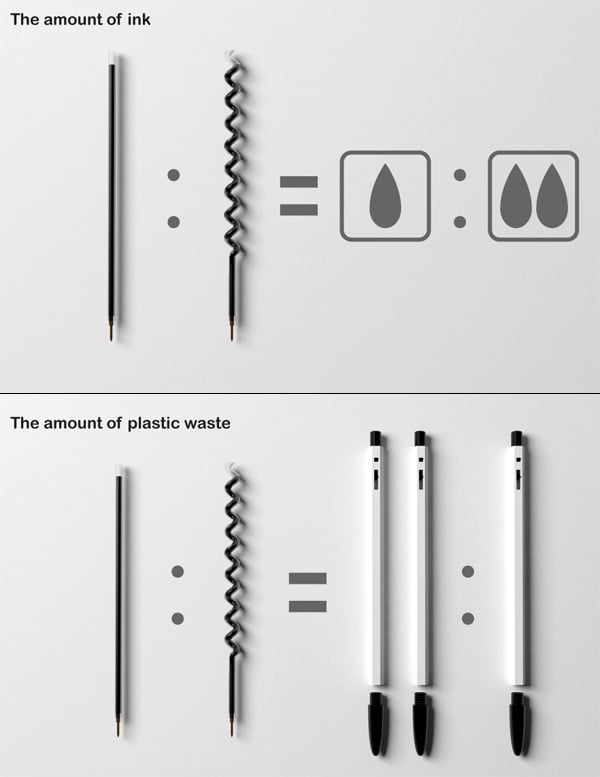
More product design, click here
Subscribe to:
Posts (Atom)